
Coșul dumneavoastră este gol
Începeți să vă construiți colecția de cercetare.
Răsfoiți toate produseleA research-lab overview of Kisspeptin-10, the KISS1R/GPR54 receptor, and its role in HPG axis regulation, GnRH pulse generation, and preclinical reproductive studies.
Revizuit de Anca Boboc, CertaPeptides
⚠️ For Research Purposes Only — The information in this article is provided strictly as a scientific reference for qualified laboratory researchers. Kisspeptin-10 and related compounds discussed here are not approved for human or veterinary use, are not drugs, and are not intended to diagnose, treat, cure, or prevent any disease. All experimental work should be performed only by trained personnel under appropriate institutional oversight.
Few neuropeptides have rewritten a textbook as quickly as kisspeptin. In the space of roughly two decades, what began as the product of an obscure metastasis-suppressor gene (KISS1) has emerged as one of the most important upstream regulators of mammalian reproduction. Today, Kisspeptin-10 — a 10-residue C-terminal fragment of the parent peptide — is one of the most widely used research tools for probing the hypothalamic–pituitary–gonadal (HPG) axis in preclinical neuroendocrine studies.
This article is a technical primer for research laboratories working with Kisspeptin-10 in vitro and in animal models. It covers:
Nothing in this article constitutes clinical or medical guidance. Kisspeptin-10 is discussed exclusively as a research reagent.
The KISS1 gene was originally cloned in 1996 from the human melanoma cell line C8161 as a metastasis suppressor — hence “kiss” (a nod to Hershey, Pennsylvania’s “Kisses”). The primary translation product is a 145-amino acid precursor that is proteolytically processed into a 54-residue mature peptide, kisspeptin-54 (also known historically as metastin). Further cleavage yields shorter biologically active fragments sharing a common C-terminal decapeptide: Kisspeptin-10 (Tyr-Asn-Trp-Asn-Ser-Phe-Gly-Leu-Arg-Phe-NH₂).
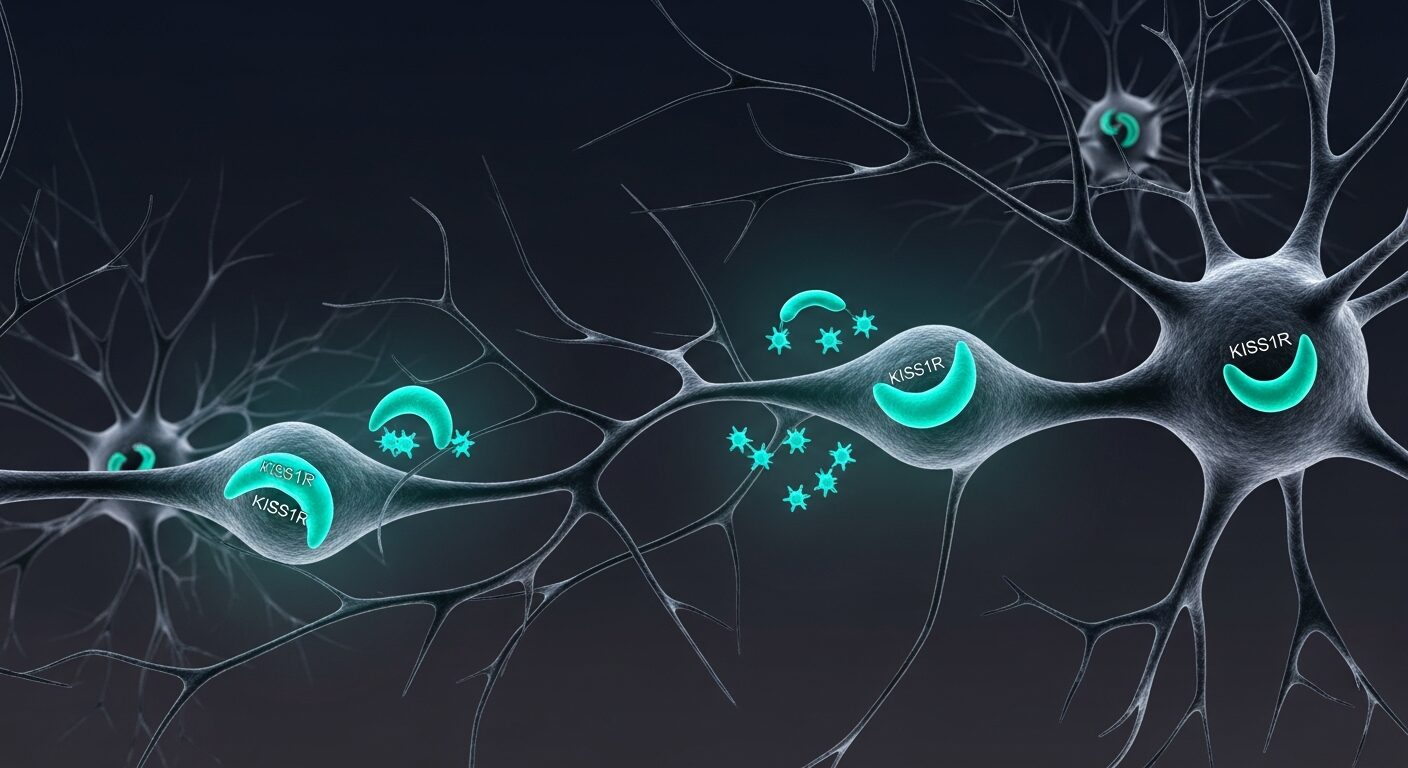
All these fragments — KP-54, KP-14, KP-13, and KP-10 — act as full agonists at the same receptor: KISS1R, previously designated GPR54. KISS1R is a class A (rhodopsin-like) G protein-coupled receptor that signals predominantly through Gα_q/11, activating phospholipase C-β, generating IP₃ and diacylglycerol, mobilizing intracellular Ca²⁺, and activating protein kinase C and MAPK/ERK pathways.
The physiological relevance of this pathway was established when two independent groups in 2003 reported that loss-of-function mutations in KISS1R/GPR54 cause normosmic hypogonadotropic hypogonadism in humans and that Gpr54-null mice fail to enter puberty despite having morphologically normal GnRH neurons. Colledge’s 2004 review in Trends in Endocrinology and Metabolism consolidated these findings and established KISS1R as an obligate upstream gate for GnRH secretion (Colledge, 2004, DOI).
According to PubMed-indexed literature, kisspeptin signaling sits at the top of the reproductive neuroendocrine hierarchy: without functional KISS1R, the HPG axis cannot be activated, regardless of whether GnRH neurons, pituitary gonadotrophs, or gonads are intact.
In rodents, two major populations of kisspeptin-expressing neurons have been characterized:
In primates, the distribution is broadly similar, though the preoptic kisspeptin population is smaller and the ARC/infundibular population dominates pulse generation.
GnRH neurons themselves express KISS1R, and application of Kisspeptin-10 to GnRH neurons depolarizes them and triggers action potentials. This is the cellular basis for the axiom that “kisspeptin is the most potent known stimulator of GnRH secretion.”
Herbison’s 2007 review of the genetics of puberty highlights why research has converged on shorter kisspeptin fragments (Herbison, 2007, DOI). The minimal bioactive core of the kisspeptin family lies in the C-terminal region, and structure-activity studies have shown that the C-terminal decapeptide (KP-10) retains essentially full intrinsic activity at KISS1R compared with the 54-residue parent.
Practical reasons KP-10 dominates preclinical research:
The trade-off is that KP-10 is cleared more rapidly than KP-54 in vivo, so in continuous-infusion or pulse-mimicking paradigms, researchers must account for the shorter effective duration.
Hameed and colleagues’ 2011 review in the Journal of Endocrinology summarizes the pre-2010 rodent and primate work: peripheral or central administration of Kisspeptin-10 produces robust, dose-dependent increases in luteinizing hormone (LH) and, to a lesser extent, follicle-stimulating hormone (FSH) via stimulation of hypothalamic GnRH neurons (Hameed et al., 2011, DOI). Chronic administration produces receptor desensitization in some paradigms, providing a useful tool for studying KISS1R tachyphylaxis.
Dhillo’s 2007 review in Reviews in Endocrine and Metabolic Disorders synthesized the first generation of preclinical volunteer research (Dhillo, 2007, DOI). In controlled experimental settings, intravenous administration of kisspeptin potently increased plasma LH, with smaller effects on FSH and downstream testosterone. Plasma kisspeptin was shown to be very low in non-pregnant adults but dramatically elevated during pregnancy, with the placenta identified as the source.
George et al. (2011, DOI) specifically investigated Kisspeptin-10 in an experimental volunteer setting and found that KP-10 is a potent stimulator of LH and increases LH pulse frequency — providing direct evidence that the decapeptide acts at the level of the GnRH pulse generator rather than the pituitary.
Abbara and colleagues (2018, DOI) reported that the hypothalamic response to kisspeptin-54 and the pituitary response to GnRH were preserved in healthy older men.
Roseweir and Millar (2013, DOI) reviewed the development of peptide and small-molecule kisspeptin antagonists. These tools — used exclusively in preclinical research settings — have been invaluable for dissecting which aspects of reproductive physiology depend on endogenous KISS1R tone, including pubertal onset, estrous cyclicity, and the preovulatory LH surge.
All of the above is preclinical or experimental research data. None of it constitutes medical advice, a dosing recommendation, or an indication of safety or efficacy in any clinical population.
Kisspeptin-10 is the C-terminal decapeptide of kisspeptin-54, with the sequence:
H-Tyr-Asn-Trp-Asn-Ser-Phe-Gly-Leu-Arg-Phe-NH₂
Important structural features relevant to laboratory handling:
These chemical properties shape reconstitution and storage decisions (see Section 7).
In vitro KISS1R assays commonly used in preclinical research include:
Reported KP-10 EC₅₀ values in HEK293 or CHO cells heterologously expressing KISS1R typically fall in the 0.1–5 nM range, depending on assay format and receptor expression level. Researchers comparing analogs should always run a KP-10 reference curve on the same day to normalize between experiments.
KISS1R is primarily Gα_q/11-coupled, but like most class A GPCRs it can also recruit β-arrestin and engage Gα_i pathways in some systems. A peptide that activates Ca²⁺ signaling strongly but fails to recruit β-arrestin is said to be “Gq-biased”; the inverse is “arrestin-biased.” These distinctions matter for understanding why some kisspeptin analogs show different in vivo profiles despite identical Ca²⁺ EC₅₀ values. When designing structure–activity studies, including both Ca²⁺/IP₁ and β-arrestin readouts for each analog is the gold standard.
KISS1R sequence conservation is high among mammals, but not perfect. Rodent KISS1R and human KISS1R differ in a small number of residues within the ligand-binding pocket, which can produce 2–10-fold potency differences for certain analogs. When running cross-species comparative studies, confirm the species origin of the receptor construct used in each assay.
The decapeptide scaffold of KP-10 has been extensively mined for structure-activity relationships in preclinical research. Key findings:
These SAR data underpin the rational design of kisspeptin antagonists, agonist analogs with altered pharmacokinetics, and photo-affinity probes for receptor mapping studies.
Kisspeptin-10 is reasonably soluble in aqueous buffers due to its polar residues (Asn, Ser) and basic C-terminal Arg. Suggested approaches for research use:
For lyophilized reference material:
For reconstituted working solutions:
If you are maintaining a stock over months, periodically re-check purity by RP-HPLC and identity by LC-MS. Signs of degradation include new HPLC peaks, broadening of the main peak, and the appearance of mass peaks +16 (oxidation) or −17 (deamidation + cyclization) relative to the intact peptide.
In rodent or larger-animal preclinical studies, additional considerations apply:
One of the most studied features of KISS1R pharmacology in research settings is its capacity for rapid desensitization. Sustained exposure to kisspeptin — whether in vitro by prolonged incubation or in vivo by continuous infusion — produces a progressive decline in downstream signaling that is qualitatively distinct from simple receptor occupancy. This has both practical and scientific implications:
For structure–activity studies of analogs intended as long-acting research tools, desensitization profiles should be characterized in parallel with acute potency. A compound that is equipotent to KP-10 in an acute Ca²⁺ assay but produces more sustained signaling without desensitization could be a more useful research tool for chronic studies — or, conversely, could produce confounding off-target effects via non-physiological tonic activation.
Q1: What is the difference between Kisspeptin-10, Kisspeptin-54, and “metastin”?
Kisspeptin-54 is the mature cleavage product of the prepro-kisspeptin precursor. “Metastin” is an older name for the same peptide, derived from its original identification as a metastasis suppressor. Kisspeptin-10 is the C-terminal 10 amino acids of kisspeptin-54 and retains full intrinsic activity at KISS1R. For most in vitro mechanistic research, KP-10 is preferred; for longer-duration in vivo paradigms, KP-54 may be chosen for its longer plasma half-life.
Q2: Is Kisspeptin-10 selective for KISS1R?
Kisspeptin-10 is highly selective for KISS1R compared with most unrelated GPCRs, but it shares the RFamide C-terminal motif with other RFamide-family peptides. Cross-reactivity with NPFF receptors has been reported at high micromolar concentrations but is not a concern at the low-nanomolar concentrations used in typical KISS1R assays.
Q3: How should I handle Kisspeptin-10 to preserve activity?
Keep lyophilized material desiccated at −20 °C or −80 °C. Prepare single-use aliquots upon reconstitution. Include carrier protein (0.1% BSA) in dilute working solutions to prevent adsorption. Avoid repeated freeze–thaw and prolonged exposure to alkaline pH.
Q4: What vehicle should I use for in vitro KP-10 assays?
HEPES- or bicarbonate-buffered saline at physiological pH (7.2–7.4) with 0.1% BSA is a standard starting point. For Ca²⁺ imaging, HBSS with HEPES and BSA works well. Avoid buffers containing divalent cation chelators if you care about KISS1R coupling efficiency.
Q5: Why do reported potencies vary across papers?
Differences in KISS1R expression level, cellular background (HEK vs. CHO vs. primary neurons), assay readout (Ca²⁺ vs. IP₁ vs. ERK vs. β-arrestin), and peptide purity all contribute. Always normalize to a same-day reference curve, and report the assay conditions in full in your methods section.
Citations retrieved from PubMed. Please consult the original sources for full methodological detail.
Not for human consumption. For laboratory research only.
Disclaimer: All products sold by CertaPeptides are intended for research purposes only. Not for human or veterinary use. Not for consumption. Nothing in this article is medical advice, and no claims of safety, efficacy, diagnosis, treatment, prevention, or cure are made for Kisspeptin-10 or any related compound. Researchers are responsible for complying with all applicable laws, institutional policies, and ethical guidelines governing the handling of research peptides.
Verificați înainte de a cerceta
Paginile de produs afișează o specificație la nivel de clasă, acolo unde există una în evidență, iar loturile selectate sunt însoțite de un COA independent de la o terță parte.
Compuși de cercetare asociați
Paginile de produs afișează o specificație la nivel de clasă, acolo unde există una în evidență; loturile selectate au un COA independent, emis de o terță parte. Introduceți codul de pe eticheta flaconului dumneavoastră pe pagina noastră de verificare. Dacă la căutarea codului nu se găsește nimic, trimiteți-ne acel cod prin e-mail.
Oferiți 15% reducere, câștigați 10% înapoi la prima comandă pe care o plasează.