
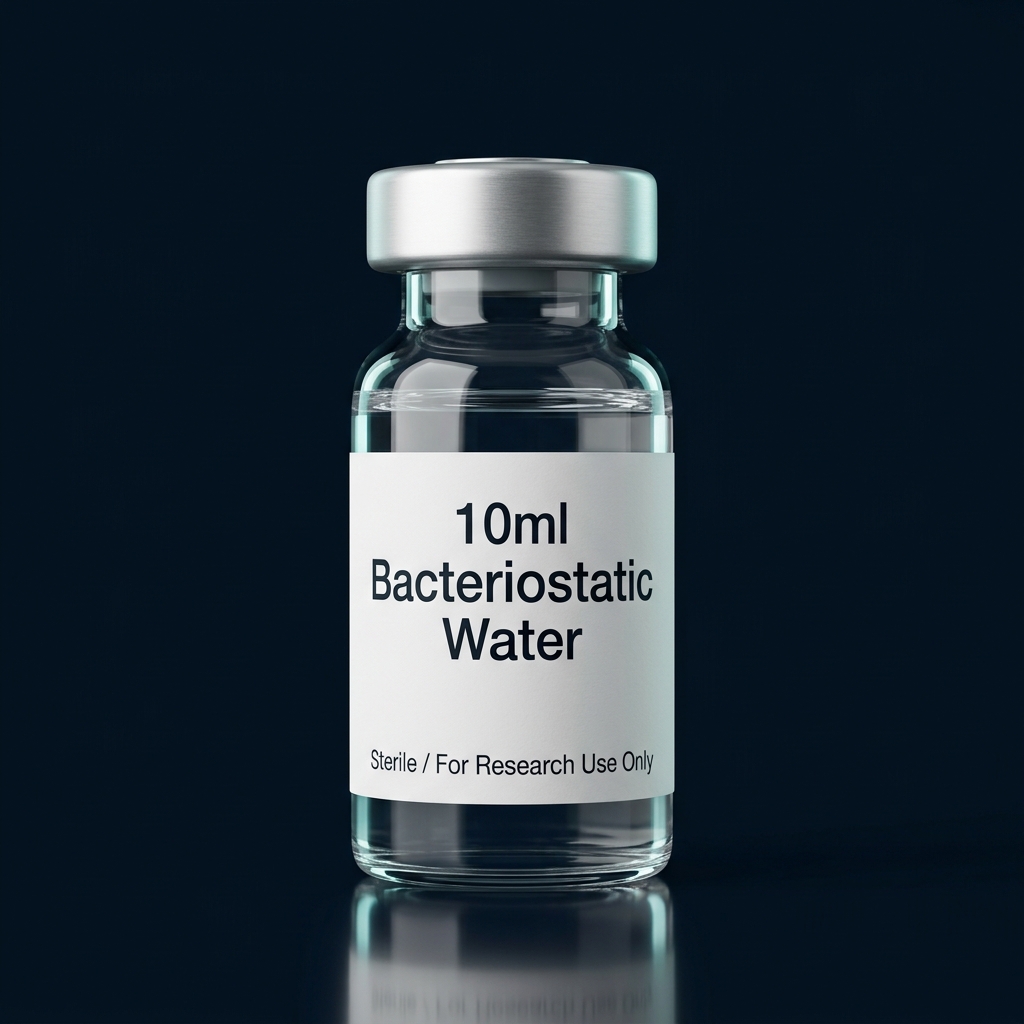
Bacteriostatic Water
Bacteriostatic Water · Result: Content quantification (Janoshik) · Report Code: H63R5HRGK5XG · Test Date: 2026-05-25 · Lab: Janoshik Analytical
View independent report #155229 ↗♢ Research use only Klassespecifikation; udvalgte partier Janoshik-testet
Indholdsanalyse Content quantification (Janoshik)Bacteriostatic Water · Report #155229 ↗Free standard EU shipping on orders over €200
If a product doesn't match the specification on its published COA, contact us with your batch number: we investigate against the lot's report and replace any product that fails it, at no cost to you.
Contact us within 48 hours of delivery with photos of the outer box, inner packing, and any affected vials with labels legible. Confirmed transit damage is replaced at no cost to you.
Returns policy →3–7 days most of the EU · 10–14 Nordics/Baltics. Dispatched within 1–2 business days. Check destination rates at checkout.
Full shipping informationBakteriostatisk vand af USP-kvalitet (3ml, 5ml eller 10ml hætteglas) med 0.9% benzylalkohol. Sterilt, endotoksintestet. Til rekonstitution af peptider.
Bacteriostatic water is sterile water containing 0.9% benzyl alcohol (9mg per ml) as a bacteriostatic preservative. It is the standard reconstitution medium for research peptides that will be stored after preparation and used over multiple sessions. The benzyl alcohol does not sterilize — it does not kill existing contamination — but it prevents bacterial growth from needle punctures and environmental exposure, extending the usable window of a reconstituted peptide solution to approximately 28-30 days when kept refrigerated.
Any peptide protocol that involves reconstituting a vial and using it for multiple doses over days or weeks should use bacteriostatic water. The alternative — sterile water — has no preservative action and is appropriate only for single-use, immediate-consumption reconstitutions. In practice, most research protocols involving peptides dosed repeatedly in animal studies or kept as working stocks in cell culture work default to bacteriostatic water for this reason.
One consideration: benzyl alcohol is biologically active at higher concentrations. At 0.9% in a reconstitution vial, the contribution to a typical in vivo dose or in vitro working concentration is negligible. However, if you are performing a sensitive cell viability assay or working with very high volumes of reconstituted solution per experiment, it is worth calculating the final benzyl alcohol concentration in the experimental medium and comparing to known cytotoxicity thresholds (generally above 0.1% in culture).
| Parameter | Value |
|---|---|
| Volume | 3ml, 5ml or 10ml vial |
| Preservative | 0.9% benzyl alcohol (9mg/ml) |
| pH | 4.5 – 7.0 |
| Sterility | Sterile filtered |
| Endotoxins | <0.5 EU/ml |
Store unopened vials at room temperature or at 4°C, away from light. Once the vial septum has been punctured, refrigerate at 2-8°C and use within 28 days. Label with opening date. Discard if the solution becomes cloudy, discolored, or if visible particulates appear — all of which indicate contamination despite the preservative. Do not freeze bacteriostatic water as this can cause precipitation.
For the vast majority of synthetic research peptides, yes. The main exceptions are highly acid-sensitive or base-sensitive sequences where the pH 4.5-7.0 range of bacteriostatic water could affect stability, and some labile peptides where even the small amount of benzyl alcohol might interfere with the assay. For most standard peptides — BPC-157, GLP-1 analogues — bacteriostatic water is fully compatible and is the recommended reconstitution medium.
That is determined by the working concentration your assay requires, not by the solvent. Concentration is simply the peptide mass in the vial divided by the volume of solvent added: 2mg reconstituted in 2ml gives 1mg/ml, and 5mg in 2.5ml gives 2mg/ml. Choose the volume that puts the compound in the concentration range your protocol calls for, and keep the total within the vial’s capacity. Note that a larger reconstitution volume means a more dilute solution.
Bacteriostatic water is supplied for laboratory research. For research purposes only.
| Parameter | Værdi |
|---|---|
| Volumen | 3ml, 5ml eller 10ml hætteglas |
| Konserveringsmiddel | 0.9% benzylalkohol (9mg/ml) |
| pH | 4.5 - 7.0 |
| Sterilitet | Sterilt filtreret |
| Endotoksiner | <0.5 EU/ml |
Bacteriostatic Water · Result: Content quantification (Janoshik) · Report Code: H63R5HRGK5XG · Test Date: 2026-05-25 · Lab: Janoshik Analytical
View independent report #155229 ↗Follow the storage conditions on the product label and its published documentation. Handle only in an appropriately equipped laboratory.
Peptide Reconstitution Calculator →