
Ihr Warenkorb ist leer
Beginnen Sie mit dem Aufbau Ihrer Forschungssammlung.
Alle Produkte durchsuchen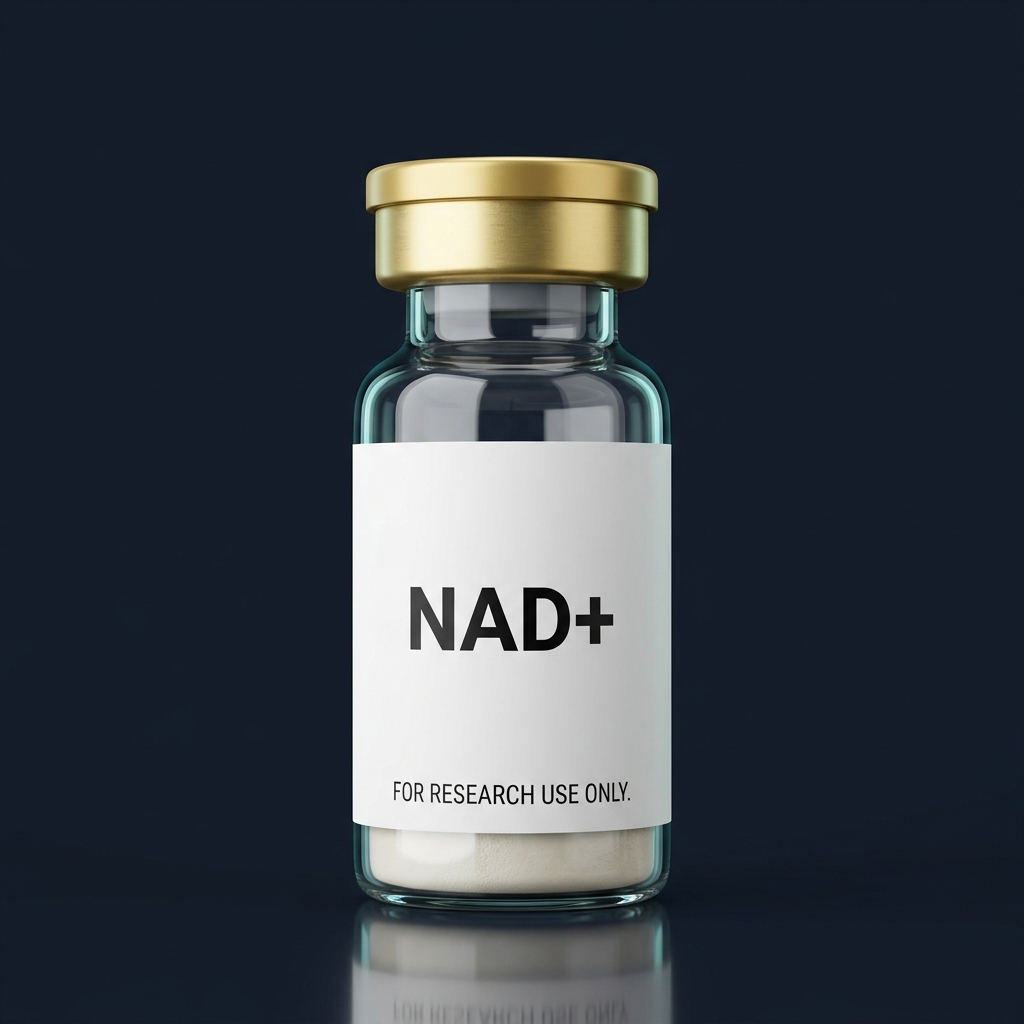
♢ Research use only Klassenspezifikation; ausgewählte Chargen Janoshik-getestet
Free standard EU shipping on orders over €200
If a product doesn't match the specification on its published COA, contact us with your batch number: we investigate against the lot's report and replace any product that fails it, at no cost to you.
Contact us within 48 hours of delivery with photos of the outer box, inner packing, and any affected vials with labels legible. Confirmed transit damage is replaced at no cost to you.
Returns policy →3–7 days most of the EU · 10–14 Nordics/Baltics. Dispatched within 1–2 business days. Check destination rates at checkout.
Full shipping informationNicotinamidadenindinukleotid (NAD+) ist ein essenzielles Coenzym, das in allen lebenden Zellen vorhanden ist und als kritischer Elektronenüberträger bei der oxidativen Phosphorylierung, der ATP-Produktion, der DNA-Reparatur und kalziumabhängigen Signalwegen dient. Geliefert als lyophilisiertes Pulver; Spezifikation auf Klassenebene ≥98% NAD+ (β-Form, mittels HPLC). Nur für Forschungszwecke. Nicht für den menschlichen Verzehr.
Nicotinamide adenine dinucleotide (NAD+) is a central coenzyme in cellular energy metabolism, serving as the electron carrier in mitochondrial oxidative phosphorylation and as a substrate for a class of enzymes — sirtuins, PARPs, and CD38/CD157 ectoenzymes — that use NAD+ in non-redox signaling reactions. Its role as a sirtuin substrate is what drove the surge of interest in NAD+ biology over the past two decades: sirtuins (SIRT1-7) regulate protein deacetylation, mitochondrial biogenesis, DNA repair, and inflammatory signaling in ways that appear to overlap significantly with NAD+ and sirtuin-pathway activity. The problem is that NAD+ levels decline measurably with age across most mammalian tissues studied.
The decline in NAD+ with aging has been attributed to increased consumption (more PARP activity in response to accumulated DNA damage, more CD38 activity during chronic inflammation) combined with reduced biosynthesis from precursors. This has made NAD+ and its precursors (NMN, NR, niacin, tryptophan) major targets in aging and metabolic research. The mechanistic questions are far from settled: which NAD+-consuming enzyme is most relevant to age-related pathology varies by tissue, and whether raising NAD+ levels achieves meaningful SIRT1 activation in vivo under normal dietary conditions is genuinely debated.
Direct NAD+ supplementation has the bioavailability challenge that the molecule is poorly membrane-permeable and is degraded in the gut. Precursor approaches (NMN, NR) have better oral bioavailability but add their own pharmacokinetic complexity. Research applications for research-grade NAD+ include cell culture experiments where you want to raise intracellular NAD+ acutely without precursor conversion kinetics, and in vivo bolus studies examining short-term NAD+-dependent signaling events.
| Parameter | Value |
|---|---|
| Compound | Nicotinamide adenine dinucleotide (NAD+) |
| Form | Lyophilized powder (free acid or sodium salt) |
| Reinheit | ≥98% (class-level specification) |
| Molecular weight | 663.4 Da |
| Solubility | Water-soluble |
| Analysenzertifikat | Available on request |
Store at -20°C, protected from light and moisture. NAD+ is significantly less stable than its precursors NMN and NR — the adenylate ester bond is hydrolyzable under acidic conditions and NAD+ oxidizes to NADH and vice versa in non-inert atmospheres. Reconstitute in cold, pH-neutral water immediately before use and do not store reconstituted solutions. Single-use aliquots from the lyophilized stock are the practical approach for sensitive experiments.
The enzymatic cycling assay (NAD/NADH quantification kit) is the standard for cell culture work — it uses alcohol dehydrogenase to cycle NAD+ through a colorimetric or fluorometric reaction and gives absolute NAD+ and NADH values from a cell extract. Mass spectrometry-based methods provide more specific quantification with isotope-labeled internal standards and can distinguish NAD+ from its close relatives (NADH, NADP+, NADPH) simultaneously. For tissue-level NAD+ measurement in animals, tissue extraction followed by enzymatic assay is standard. Important: NAD+ is unstable ex vivo — samples must be processed within minutes of collection and immediately acidified to stabilize the oxidized form.
This is a key translational question. NAD+ is a large, charged molecule that crosses plasma membranes poorly in most cell types — it is generally assumed to enter via specific transporters or extracellular degradation to precursors (NMN, NR, Nam) followed by re-synthesis. In cell culture experiments where you add NAD+ to media, the intracellular rise you observe may reflect extracellular signaling (through cell-surface receptors, particularly NAD+-sensitive P2 receptors) or precursor recycling rather than direct membrane crossing. This should be controlled for by measuring intracellular NAD+ alongside extracellular levels and comparing to equimolar precursor conditions.
NAD+ is supplied for laboratory research. Not for human use. For research purposes only.
| Parameter | Wert |
|---|---|
| Substanz | Nicotinamidadenindinukleotid (NAD+) |
| Form | Lyophilisiertes Pulver (freie Säure oder Natriumsalz) |
| Reinheit | ≥98% (Spezifikation auf Klassenebene) |
| Molekulargewicht | 663.4 Da |
| Löslichkeit | Wasserlöslich |
| Analysenzertifikat | Auf Anfrage erhältlich |
No independent report is currently published for this product. A class-level specification is not an independent lot test.
Follow the storage conditions on the product label and its published documentation. Handle only in an appropriately equipped laboratory.
Peptide Reconstitution Calculator →Vertrauen der Forschenden
Wer testet das eigentlich?
Ausgewählte Chargen werden unabhängig von Janoshik Analytical (Tschechische Republik) geprüft und im öffentlichen Janoshik-Portal veröffentlicht. Andere Chargen werden mit der Chargenspezifikation des Lieferanten versendet. Siehe /coa für die veröffentlichte Übersicht.
COAs ansehen →Was ist, wenn ich die falsche Charge erhalte?
Jedes Fläschchen trägt auf dem Etikett einen Code. Schlagen Sie ihn auf unserer Verifizierungsseite nach: Dort sehen Sie, was CertaPeptides zu diesem Code veröffentlicht, und bei einer zurückgezogenen Charge, dass sie zurückgezogen wurde, und warum. Ist Ihre Charge zurückgezogen oder findet die Suche zu dem Code auf Ihrem Etikett nichts, schreiben Sie uns diesen Code per E-Mail.
COAs ansehen →Von wo wird versendet?
Rumänien (EU). Wir sind CERTALAB SRL, CUI 54169956, umsatzsteuerlich registriert. Sameday für Rumänien, GLS für die meisten EU-Ziele, TCE Worldwide für die übrigen grenzüberschreitenden EU- und Nicht-EU-Märkte (Vereinigtes Königreich, Schweiz). Lieferung in 1–15 Werktagen je nach Zielort — genauer Zeitraum wird an der Kasse angezeigt.
Versanddetails →Was ist, wenn es ein Problem gibt?
Sie haben ein 14-tägiges Widerrufsrecht gemäß OUG 34/2014 (rumänisches/EU-Verbraucherrecht), mit der Möglichkeit zur Eskalation an die ANPC und zur alternativen Streitbeilegung (SAL). Kontaktieren Sie uns unter support@chinapeptideshop.com.
Rückgaberichtlinie →Dieses Produkt ist ausschließlich für wissenschaftliche Forschungs- und Entwicklungszwecke bestimmt. Es handelt sich um eine chemische Substanz, die nicht als Arzneimittel, Medikament, Wirkstoff oder Bestandteil in einem zum menschlichen oder tierischen Verzehr bestimmten Produkt verwendet werden darf. Forschende müssen diese Verbindung in Übereinstimmung mit den Biosicherheitsrichtlinien ihrer Einrichtung handhaben. Verwenden Sie sie nur in ordnungsgemäß ausgestatteten Laborumgebungen mit geeigneter persönlicher Schutzausrüstung.
Peptide in lyophilisierter (gefriergetrockneter) Form werden in versiegelten Glasfläschchen mit Standardversandverfahren versendet und müssen während des Transports nicht gekühlt werden. Lyophilisierte Peptide sind bei Umgebungstemperaturen für die Dauer des Standardversands hochstabil (die typischen Transportzeiträume werden an der Kasse angezeigt). Überführen Sie das Produkt nach dem Erhalt umgehend in eine gekühlte Lagerung (2–8°C).
Forschungspeptide werden in lyophilisierter (gefriergetrockneter) Form geliefert. Die Materialmenge beträgt typischerweise nur wenige Milligramm — sie erscheint als sehr dünner Film oder kleines Pellet am Boden des Fläschchens, oft nahezu unsichtbar. Das ist völlig normal.
Anders als manche Lieferanten, die Füllstoffe (wie Mannitol) hinzufügen, liefert CertaPeptides reines Peptid ohne unnötige Zusatzstoffe.
Combined Price €162.46
View All Products NAD+
NAD+ Retatrutide
 MOTS-c
 GHK-Cu