
Το καλάθι σας είναι άδειο
Ξεκινήστε να χτίζετε την ερευνητική σας συλλογή.
Περιηγηθείτε σε όλα τα προϊόντα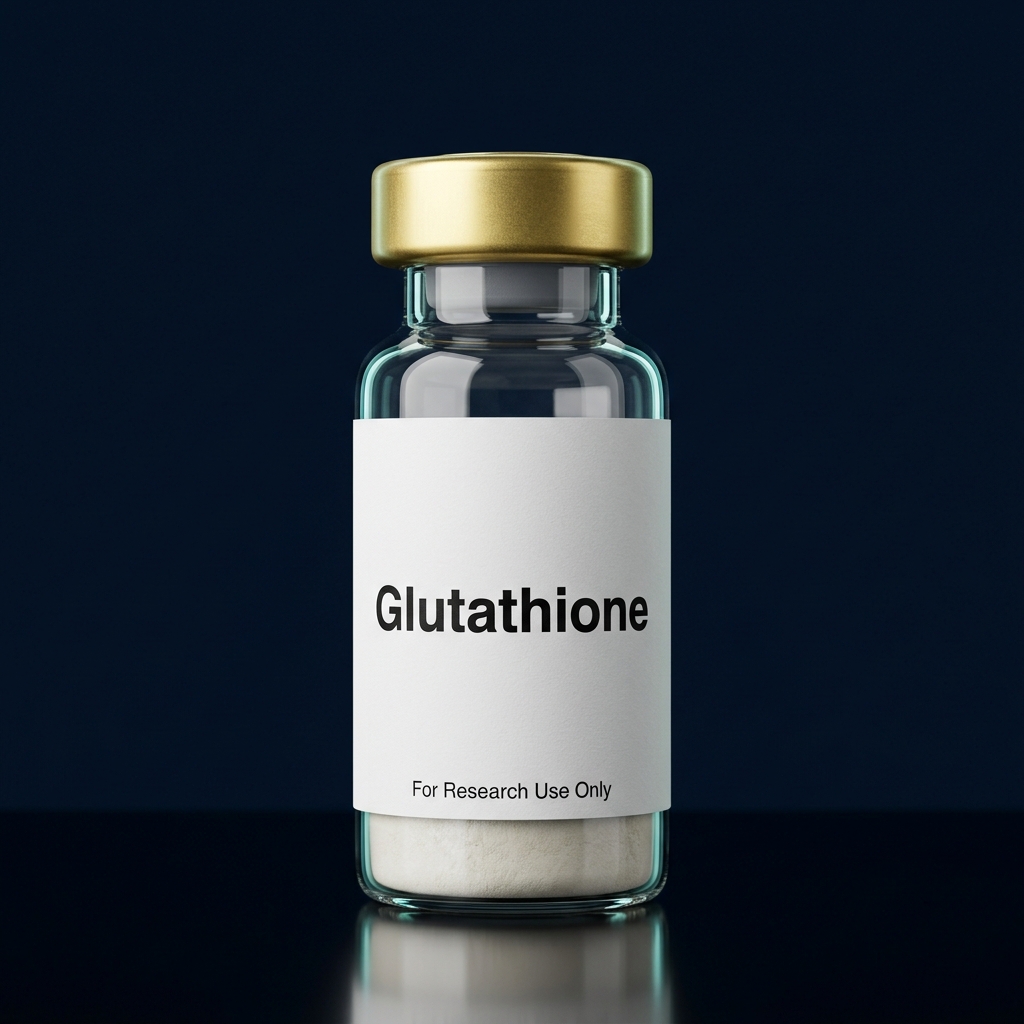
♢ Research use only No supplier COA published for this product
10 vials per kit
Express 3–7 days USD 90 / Standard 8–15 days USD 60. Choose at checkout. No free shipping.
If a product doesn't match the specification on its published COA, contact us with your batch number: we investigate against the lot's report and replace any product that fails it, at no cost to you.
Contact us within 48 hours of delivery with photos of the outer box, inner packing, and any affected vials with labels legible. Confirmed transit damage is replaced at no cost to you.
Returns policy →Express 3–7 days USD 90 / Standard 8–15 days USD 60. Choose at checkout. Customs clearance and local delivery may cause delays. No free shipping.
Full shipping informationResearch-grade Glutathione. Class-level specification ≥98% reduced glutathione (GSH, by HPLC). Lyophilized powder in sealed glass vial. For research purposes only. Not for human consumption.
Glutathione (GSH) is the most abundant intracellular antioxidant, present in virtually all mammalian cells at millimolar concentrations. It is a tripeptide (gamma-Glu-Cys-Gly) synthesized from glutamate, cysteine, and glycine, with the thiol group of cysteine providing the reducing power. As the cell’s primary buffer against oxidative stress, GSH participates in detoxification of reactive oxygen species and xenobiotics, supports the function of glutathione peroxidase enzymes, and maintains protein thiol status. Each vial contains 1,500mg of reduced glutathione (GSH).
The cellular glutathione system operates in a redox cycle: reduced GSH is oxidized to GSSG (glutathione disulfide) when neutralizing oxidants, and glutathione reductase regenerates GSH using NADPH. Monitoring the GSH/GSSG ratio is a standard measure of cellular redox status — a low ratio indicates oxidative stress. Supplementing cells or tissues with exogenous GSH provides direct antioxidant capacity and supports this redox cycle. Research applications include oxidative stress models, liver toxicity studies (the liver is the main GSH-producing organ), immune cell function (lymphocytes have high GSH requirements), and mitochondrial biology.
A practical note for in vivo research: orally administered GSH is substantially degraded in the GI tract and poorly absorbed intact. For systemic antioxidant effects in animal models, IV or IP administration is more reliable. N-acetylcysteine (NAC) is often used as an alternative because it provides cysteine for intracellular GSH synthesis and has better oral bioavailability.
| Parameter | Value |
|---|---|
| Compound | Glutathione (reduced form, L-glutathione, GSH) |
| Amount per Vial | 1,500mg |
| Αριθμός CAS | 70-18-8 |
| Καθαρότητα | ≥ 98% reduced glutathione (GSH, by HPLC; class-level specification) |
| Format | Lyophilized powder |
| Αποθήκευση | -20°C, protect from oxygen and light |
Store at -20°C in a sealed container. Reduced glutathione oxidizes readily — protect from air, moisture, and light. The thiol group is sensitive to oxidation; store in nitrogen-purged vials if available. After weighing, use promptly to minimize air exposure.
The liver produces more glutathione than any other organ and is the primary source of plasma GSH. Hepatic GSH serves several critical functions: it conjugates with electrophilic metabolites produced during drug metabolism (Phase II detoxification via glutathione S-transferases), neutralizes reactive oxygen species generated by cytochrome P450 enzymes (Phase I metabolism), and provides GSH for export to other tissues. Acetaminophen hepatotoxicity is the classic example of hepatic GSH depletion — the toxic metabolite NAPQI depletes GSH stores, and when GSH is exhausted, NAPQI causes oxidative damage. This mechanism is why NAC (GSH precursor) is the antidote for acetaminophen overdose.
Reduced glutathione (GSH) is a tripeptide, and the intestinal epithelium has limited transport capacity for intact peptides — most are hydrolyzed by brush border peptidases to free amino acids before absorption. Studies using isotope-labeled GSH have shown that while some intact GSH may be absorbed, most is broken down in the GI tract. The absorbed free amino acids can support intracellular GSH synthesis, but the contribution of oral GSH to tissue antioxidant capacity is less than IV or IP delivery. Liposomal formulations and specific dipeptide forms (like gamma-glutamylcysteine) have been studied for better oral bioavailability, but for research requiring defined GSH supplementation, parenteral routes are more reliable.
Lymphocytes and macrophages have particularly high GSH requirements and are sensitive to oxidative stress. GSH depletion impairs T-cell proliferation, reduces NK cell cytotoxicity, and shifts the Th1/Th2 balance toward Th2 (reducing cell-mediated immunity). HIV infection is associated with systemic GSH depletion, which has made GSH biology relevant to AIDS immunology. In research contexts, manipulating GSH levels with GSH, NAC, or GSH-depleting agents (like BSO — buthionine sulfoximine) allows investigation of redox-dependent immune cell functions. Restoring GSH in oxidatively stressed immune cells is a standard experiment in immunological research on aging and chronic disease.
Glutathione is supplied for research purposes only. Handle in compliance with institutional biosafety guidelines.
| Parameter | Value |
|---|---|
| Compound | Glutathione (reduced form, L-glutathione, GSH) |
| Amount per Vial | 1,500mg |
| Αριθμός CAS | 70-18-8 |
| Καθαρότητα | ≥ 98% reduced glutathione (GSH, by HPLC; class-level specification) |
| Format | Lyophilized powder |
| Αποθήκευση | -20°C, protect from oxygen and light |
Store at -20°C in a sealed container. Reduced glutathione oxidizes readily — protect from air, moisture, and light. The thiol group is sensitive to oxidation; store in nitrogen-purged vials if available. After weighing, use promptly to minimize air exposure.
AOD9604 laboratory research catalog item. Supplied per kit of 10 vials; choose the listed specification. Not for human or veterinary use.
Adipotide ερευνητικής ποιότητας. Προδιαγραφή σε επίπεδο κατηγορίας ≥98%. Λυοφιλοποιημένη σκόνη σε σφραγισμένο γυάλινο φιαλίδιο. Μόνο για ερευνητικούς σκοπούς. Δεν προορίζεται για ανθρώπινη κατανάλωση.
AICAR laboratory research catalog item. Supplied per kit of 10 vials; choose the listed specification. Not for human or veterinary use.
Δώστε 10% έκπτωση και κερδίστε 10% επιστροφή στην πρώτη παραγγελία που πραγματοποιεί. First-order referral discounts cannot be combined with other discounts.