
研究与指南
ACTH Peptide vs Cosyntropin: Why the Fragment Matters
1 11 月, 2026
本文为英文原文。Read the English original
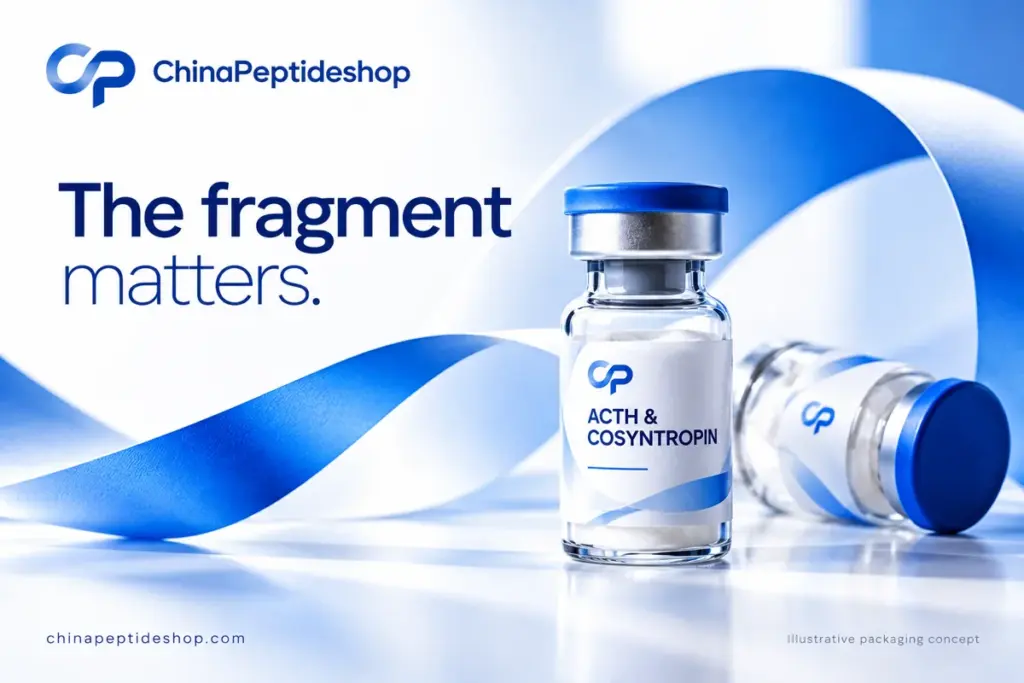
ACTH and cosyntropin are related names, but they do not describe an identical peptide sequence. Naturally occurring ACTH has 39 amino acids. Cosyntropin corresponds to its first 24. That difference is the place to start when comparing documents.
We find this a useful case because a familiar hormone name can make an identity question seem settled before it has been asked. A milligram amount tells you a quantity. It does not tell you which fragment, salt form or finished preparation is present.
What the official label says
The FDA’s 2024 CORTROSYN label describes cosyntropin as a synthetic polypeptide comprising the first 24 amino acids of natural ACTH, which contains 39. The labeled drug is a diagnostic agent used with other tests to screen for adrenocortical insufficiency in adults and pediatric patients. This description concerns that specific labeled medicine.
The same label lists hypersensitivity as a contraindication and reports hypersensitivity reactions, including anaphylaxis. This article does not reproduce testing instructions or provide a way to use a research peptide for a clinical test. The dated label is an identity reference here, not a claim that a catalog product has drug approval.
Why a fragment name changes the comparison
If one document discusses ACTH and another discusses ACTH(1-24), ask whether the first author means the full hormone, a fragment or a specific medicine. Those details affect whether the comparison is even about the same material.
A full sequence designation is especially useful when reading an analytical record. A reported molecular mass has to be interpreted against the intended structure. It should not be matched to a broad name alone when more than one related sequence could be meant.
Three documents, three different jobs
A medicine label defines a particular regulated preparation and its approved use. A research paper describes the material and experimental conditions used by its authors. A supplier’s product record describes what is offered in the catalog. None automatically fills in missing information in either of the other two.
For example, finding a clinical label for cosyntropin does not establish the sequence or approval status of an item listed simply as ACTH. Likewise, a research vial bearing a hormone name is not automatically interchangeable with a finished diagnostic medicine.
The practical question for an ACTH research listing
Before interpreting a finding, identify the exact sequence intended by the source. Then compare it with the material record. Where a listing does not specify the fragment, ask for clarification instead of assuming that a quantity resolves the ambiguity.
的 ACTH catalog entry at ChinaPeptideshop is a research-product listing. It should not be represented as CORTROSYN or as a substitute for a diagnostic medicine. The COA resource can help locate documentation, but the scope of each document still needs to be checked.
Our conclusion is straightforward: the fragment belongs in the conversation. Making identity explicit is a useful improvement in product information and makes the surrounding research easier to read accurately.